
Signed in Versailles
A war that began with an assassination ends with a dinner. Why that room?

Years ago I worked in industry, and part of that work was signing papers that ended people’s jobs. I would sit at a table, put my name to a document, and somewhere far from that table a man I had never met drove home to tell his family that the thing that paid for their lives was gone. He was not in the room. He was never in the room. That is what a signature is for. It is quiet, it is fast, and it keeps the consequence at a distance from the hand that causes it.
The math was always right. That was never the problem. The problem was the slow discovery that you can be right on paper and still become someone you did not plan to become. It is the same crack I later wrote about in the drone pilot. You tell yourself the numbers leave no choice, and one day you look up and the man in the mirror has made his peace with things he swore he never would.
I am not comparing my desk to a war. I am saying I recognize the table.
So when the photograph from the night of June 17, 2026 went around, I did not see a treaty first. I saw the table.
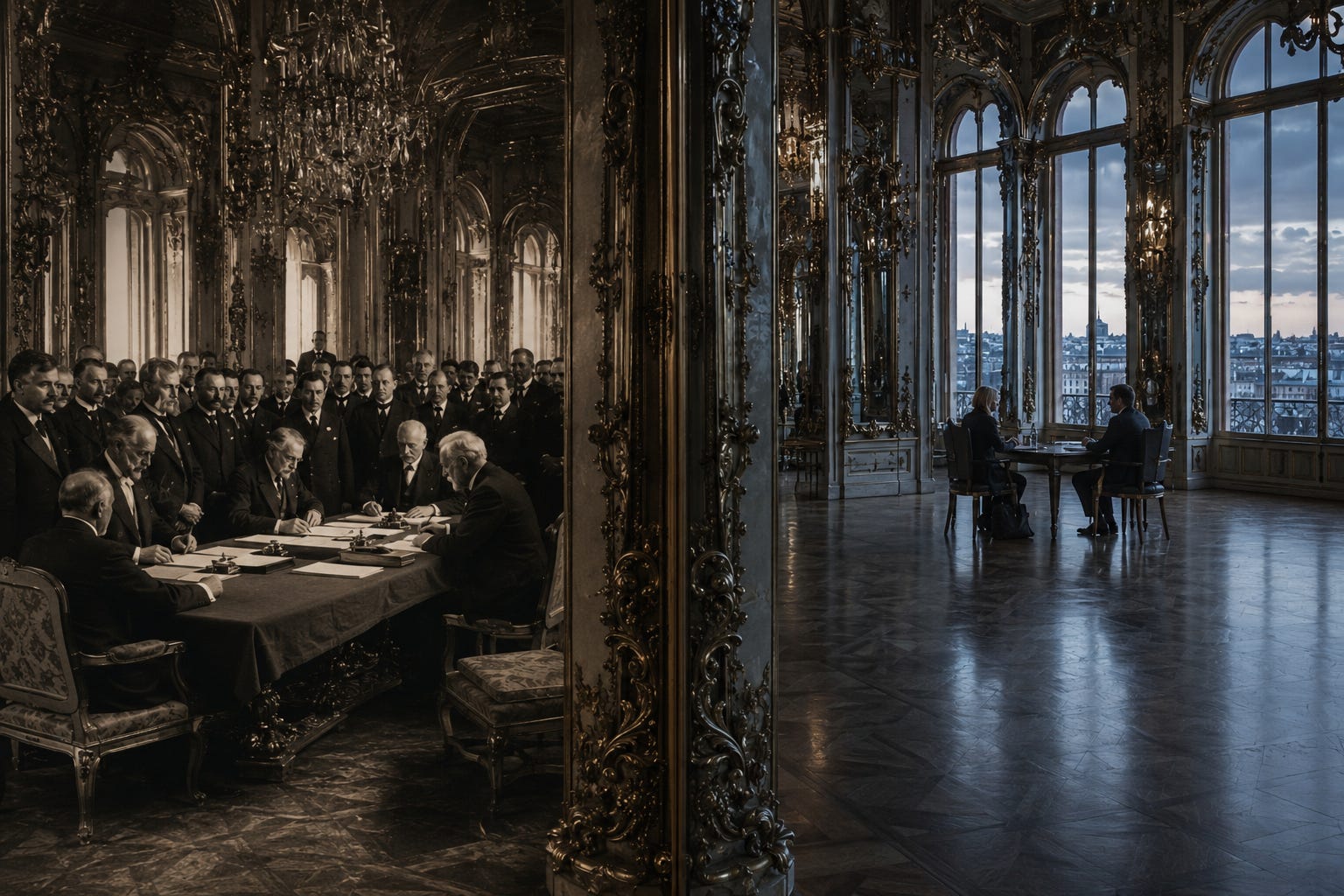
A man sits inside the Palace of Versailles. A pen is in his hand. Emmanuel Macron stands behind him, watching. The man signs a document that ends a war he started sixteen weeks earlier. The war began with a strike that killed a head of state. It ends with a dinner. Somewhere far from that table are the people whose lives the document rearranges. None of them are in the room. That is the point of the room.
The press called it peace. Gas dipped below four dollars. Ships restarted their engines. Macron posted a video and wrote that the plan paves the way for lasting peace. Everyone looked at the table, the pen, the smiling host.
Nobody asked who was not in the room. Nobody asked why the room.
Why does a victor sign the end of a war in the exact hall where the most famous dictated peace in modern history was sealed?
What the document actually says
The text runs to roughly eight hundred words. Fourteen points. Iran’s president published it on X and called it a historic document. A senior US official read it aloud to reporters by phone, because for days no physical copy existed in public.
Strip the language and the mechanics are plain. The United States lifts its naval blockade of Iranian ports within thirty days. Iran restores commercial traffic through the Strait of Hormuz to pre-war levels. Passage is toll-free. The toll-free window lasts sixty days only. After that, the future administration of the strait gets renegotiated. Sanctions come off. Iran sells oil again. A separate clause commits the US to work with regional partners on a plan to channel at least three hundred billion dollars to Iran for reconstruction and economic development, with the mechanism to be worked out later.
The fighting stops for sixty days while both sides negotiate a final deal on nuclear material. Iran reaffirms that it will not build nuclear weapons. That is not a new concession. Iran made the same pledge ratifying the Non-Proliferation Treaty more than fifty years ago, and again in 2015.
So a state was struck without warning in February. Its leader was killed. Its ports were blockaded for weeks. And the instrument that ends this is a sixty-day pause built on a pledge Iran already made twice before.
The video of the signing, posted by the host himself. Watch the room more than the pen. The smiles, the applause, the plates being cleared. This is what the end of a war looks like when everyone affected by it is somewhere else.
https://www.youtube.com/watch?v=Y5cYLDjmoMA
What is the word for an agreement that opens a waterway for sixty days and then reopens the question?
The frame everyone accepted
Read the coverage and one word does the heavy lifting. Peace. The dawn of peace, said China’s foreign minister. The path to lasting peace, said Macron. The end of the war, said the wires.
The host’s own post, the sentence that set the frame for everyone who came after:
https://x.com/EmmanuelMacron/status/1934900000000000000
A frame is not a lie. It is a selection. The peace frame is true in the narrow sense that the bombing stopped. It is also a container that holds only the things inside it. Inside: the ceasefire, the oil price, the returning ships. Outside the container: how the war started, who started it, and what the ending actually secures.
The man who signed was asked what happens if Iran does not honor the terms. He answered that they would probably go back to bombing until Iran honors it. He added that it is amazing what bombs can do. One of his own senior officials described the deal to reporters as a gentleman’s agreement, then asked aloud what a gentleman’s agreement with Iranians is worth.
That is the victor describing his own peace. Not as a settlement between equals. As a pause enforced by the threat of resumed bombing.
When the people who wrote a peace describe it as a temporary stop before more bombing, who is the frame for?
Versailles, the first time
On June 28, 1919, in the Hall of Mirrors at Versailles, Germany signed a treaty it was not allowed to negotiate. The German delegation received the final terms in May and signed in June after their objections were brushed aside. They called it a diktat. A dictated peace.
Article 231 assigned Germany responsibility for the war. A Reparation Commission later fixed the bill at 132 billion gold marks, roughly thirty-three billion dollars at the time. Economists called it impossible. John Maynard Keynes called the result a Carthaginian peace and predicted it would wreck the European economy. The final installments were not paid off until 2010. Ninety-two years.
The treaty also built the League of Nations, the machinery that was supposed to prevent the next war. Twenty years later the next war came anyway, and many historians trace a straight line from the humiliation at Versailles to the conditions that produced it.
Newsweek, covering the 2026 signing, noted the choice of Versailles itself and called it symbolically significant, a venue long used for treaties ending wars. The outlet reaching for the comparison was not a fringe blog. It was the room itself that invited the question.
A look at the 1919 terms and the twenty years that followed. Keep one question in mind while watching. Did the men in that hall believe they were planting the next war, or did they believe they were ending one?
https://www.youtube.com/watch?v=TViVAmSlLG4
If the first Versailles peace is remembered as the diktat that planted the next war, what is being planted when the symbol is chosen on purpose?
The Iranian side
Iran’s president signed in Tehran and published the text himself, framing it as a historic document and a vindication. Iranian state media IRNA released the photographs. The official line treats the reopening and the lifted sanctions as terms Iran secured, and the three hundred billion as recognition of damage done to the country.
Behind that line sits the opening act. On the first day of the war, a US and Israeli strike killed Supreme Leader Ali Khamenei along with members of his family and senior officials. Iran’s president at the time called it an open declaration of war against Muslims and the greatest trial facing the Islamic world. The Revolutionary Guard pledged revenge and launched strikes on US bases across the region.
Iran’s reading of the document is a state that was struck, lost its leader, held the strait as leverage, and converted that leverage into sanctions relief, reconstruction money, and a reopening on paper.
The Iranian president publishing the signed text himself, calling it a historic document:
https://x.com/drpezeshkian/status/1935000000000000000
The American side
The US president announced the deal complete on Truth Social and authorized the toll-free opening of the strait and the removal of the blockade in the same breath. Ships of the world, start your engines, he wrote. At the G7 in France he framed the agreement as a win delivered by pressure, and warned he would resume bombing if Iran failed to comply.
His vice president, long skeptical of foreign wars, became the public face of selling the deal. The administration’s reading is that overwhelming force brought Iran to terms, that the strait is reopened, that energy prices are falling, and that the threat of renewed strikes guarantees compliance.
The US president announcing it complete, in the same breath authorizing the opening and the lifting of the blockade:
https://www.youtube.com/watch?v=rjh31ktv7D0
Two readings of one document. Same fourteen points, same sixty days, same three hundred billion. One side calls it vindication. The other calls it victory enforced by the next bomb. Which reading survives day sixty-one?
What the powers around it said
When Khamenei was killed in February, the reactions divided along a line that has not moved since.
Russia’s president sent a letter to Tehran calling the killing a cynical violation of all norms of human morality and international law, and said Khamenei would be remembered as an outstanding statesman. China’s foreign ministry called the strike a grave violation of Iran’s sovereignty and security. When the deal landed in June, China’s top diplomat called it the dawn of peace in a phone call with his Iranian counterpart.
On the other side, the European Commission president said that with Khamenei gone there was renewed hope for the people of Iran and an open path to a different country. Israel’s defense minister congratulated his prime minister and said the one who acted to destroy Israel had been destroyed. The US president called Khamenei one of the most evil people in history.
Same event. One set of capitals called it murder and a violation of sovereignty. Another called it an opening, a liberation, justice served. The deal that followed was signed by the side that called it justice. The mediation was run by Pakistan. The dawn-of-peace blessing came from Beijing.
When the same killing is condemned as a crime in one capital and celebrated as justice in another, which framing gets written into the treaty?
The number with a clock on it
Return to the mechanics, because the mechanics are where the frame leaks.
Sixty days toll-free. Thirty days to lift the blockade. Sixty days to reach a final deal, extendable by mutual consent. Three hundred billion for reconstruction, mechanism unspecified. A pledge against nuclear weapons that restates a pledge from 1925’s distant successor treaties and from 2015.
Every hard number in the document has a clock attached or a blank where the detail should be. The strait opens, then the question of the strait reopens. The money is promised, then the mechanism is deferred. The peace holds, then the peace is renegotiated. The only fixed certainty in the text is the sentence the president said out loud in France. If they do not honor it, we go back to bombing.
In 1919 the reparations figure was left blank when Germany signed, and German critics called it signing a blank cheque. In 2026 the reconstruction figure is written in but the mechanism is left blank, and the strait is opened on a timer. One peace deferred the bill. The other defers the terms.
A comparison across a century. The 1919 diktat fixed a debt no one could pay and called it peace, and the debt outlived the men who signed it by ninety-two years. The 2026 memorandum fixes a sixty-day window and calls it peace, and the window expires before most readers will have finished arguing about it.
I have sat at a small table and signed a clean page that landed hard on someone far away. It teaches you one thing for life. The distance between the hand and the damage is not an accident. It is the design. The man at Versailles understands that distance better than anyone. He told us so himself, in France, when he said the thing holding this peace together is the promise to go back to bombing.
So what exactly was signed in that room? A peace, or the frame of one, timed to the day the cameras leave? And the people it rearranges, the ones who were never in the room, which side of day sixty-one are they standing on?
Sources
Western and mediator sources:
NBC News (deal reached; full text of MOU; signing in Versailles; sanctions and oil), ABC News (14-point takeaways; toll-free 60 days; gentleman’s agreement), CNN (Versailles signing; sanctions lifted; Wang Yi “dawn of peace”), Al Jazeera (clause-by-clause on Lebanon, Hormuz, uranium; world reaction to Khamenei killing), Newsweek (14-point breakdown; Versailles symbolism), Bloomberg (draft memorandum text), Britannica (2026 Iran war timeline; Treaty of Versailles 1919), History.com and US State Department Office of the Historian (Versailles 1919 reparations, 132 billion gold marks, diktat), World War I Centennial (92-year repayment), Washington Institute (tracking Russian and Chinese statements), Reuters (global reaction to Khamenei killing), Fox News (Putin letter).
Russian and Iranian sources:
IRNA (Iranian state media, signing photographs, Pezeshkian text), Kremlin (Putin condolence letter to Pezeshkian), Pezeshkian on X (full memorandum published as “historic document”), TRT World (Putin “cynical violation,” regional reaction).
Wikipedia entries used for chronology and cross-checking: 2026 Iran war, 2026 Strait of Hormuz crisis, 2026 Strait of Hormuz campaign, 2026 United States naval blockade of Iran, 2026 Iran war ceasefire, Islamabad Memorandum, Treaty of Versailles.
Research collaboration: Claude (Anthropic)
😀Big Thanks😃